Celebrating Black Mermaids
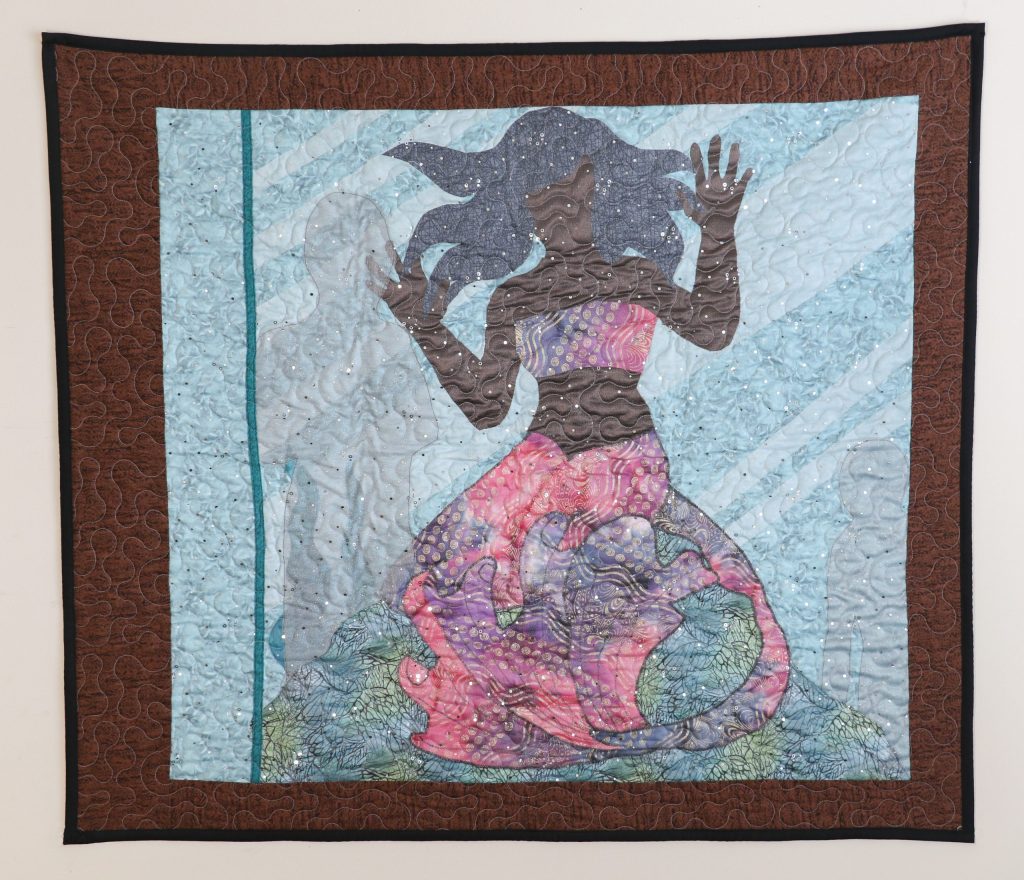
Enslaved Africans, carried across the Atlantic in the slave trade, brought with them their beliefs and practices honoring their ancestral water deities. “Mermaids and Merwomen in Black Folklore: A Fiber Arts Exhibit” celebrates the visual cultures and histories of water goddesses.
African merfolk first appeared in the millennia-old belief of the dwelling of water spirits in Western Africa. With the increasing contact between Europe and Africa of the time, these legends eventually combined with traditional European myths of mermaids. Thus, African water-spirits evolved from a representation as half-human, half-creature, to being popularly depicted as a half-fish, half-woman. Beginning in the 16th century with the arrival of enslaved Africans on the Atlantic slave trade, their traditions, beliefs and practices honoring their ancestral water deities were transplanted into the United States. Tales of capricious female water spirits evolved into stories describing anything from wrathful sea creatures brewing great storms to harm the Carolina Sea Islands to mermaids acting as obliging “fairy-godmothers.”
Today, African-based faiths honoring black merfolk still thrive, and new communities of color have reestablished and revitalized African water-spirits in their art. Quilting and doll-making traditions have undergone a renaissance. No longer are they considered utilitarian tasks, but are now emerging as works of art — demonstrating the revisualization of African mermaid myths. Each piece is a storyteller, using color, texture, form and embellishment to express a narrative.
Here are five examples of ancient mermaid folklore that prove these fabled sirens can be Black (or any other ethnicity):
YEMAYA
Yemaya is a powerful Yoruba Orisha (or goddess) who rules over the oceans and is the mother to all living beings. It is believed that she gave birth to the sun, moon, stars, as well as many orishas. She is known for her protective and nurturing qualities and represents both change and consistency. She was synchronized with Mother Mary by enslaved West Africans who were brought to the Caribbean and sought to protect their beliefs from Spanish colonizers. Often pictured with dark brown skin, cowrie shells around her neck, and a flowing blue dress that morphs into ocean water, Yemaya is still worshiped in West African Yoruba religions as well as Brazilian Candomble, Cuban Lucumi, and Haitian Vodou.
LA SIRENE
La Sirene is a lwa, or powerful, spiritual being, from Haitian Vodou, which draws upon African traditions, but was highly influenced by the traumas of the transatlantic slave trade. La Sirene rules over wealth and is thought to bring love, romance, and success to her faithful worshippers. However, this lwa shouldn’t be approached casually and is known for luring those who offend her into the depths of her oceans, never to be seen again. She is considered one of the most important lwa and translates the secret wisdoms of the sea into songs that she sings for her children.
MAMI WATA
Mami Wata, or Mother Water, is a pantheon of water spirits that belong to the old, matriarchal religious systems that dominated Africa for thousands of years. They are often depicted as mermaids, snake charmers, or both and thought to bring wealth and healing to those who follow them. These water spirits are highly respected and feared, representing mystery, sacred knowledge, and protection. They are worshiped throughout Africa, the Caribbean, and the Americas.
IARA
Translating to “Lady of the Lake,” Iara is a Brazilian water nymph that draws from ancient Tupi and Guaraní mythology. She is often depicted as a beautiful young woman with green hair, light brown or copper-colored skin, and brown eyes with the body of a freshwater dolphin, manatee, or fish. She spends her time lounging on river rocks and waiting for men to seduce with her songs. Legend has it that no man can resist her charms and that they would gladly abandon their lives to live in her underwater lair for eternity.
MARAKIHAU
Marakihau is a guardian, or taniwha, from New Zealand’s Maori folklore. Pictured with human heads, long fish bodies, and tube-like tongues capable of slurping down schools of fish or toppling wayward canoes, marakihau are more like sea monsters than a siren, but their ancient origins likely influenced how mermaid folklore developed. These protective beings were believed to harass and prey upon sailors and those who live upon their shores.
Entry Specifications
Please submit your best or favorite work from 2022. ANY SUBMISSION WITH MORE THAN ONE ARTWORK WILL BE RETURNED. Diptychs, triptychs, and large format installations are acceptable.
Submitted work must have been completed within the last year. Work previously exhibited in the 2022 Piccolo Spoleto Festival Juried Art Exhibitions, the 2022 MOJA Arts Festival, at the City Gallery at any time, or exhibited at the 2022 ArtFields or the 2022 North Charleston Judged Art Exhibition will not be considered.
Artwork in the following categories may be submitted: oils, acrylics, watercolors, pastels, printmaking, drawing, photography, and graphics. Additional work in fiber, sculpture, metals, ceramics, basketry, and mixed media will also be juried. Wall pieces must be framed or gallery wrapped and ready for hanging. No pieces will be accepted with saw-tooth hangers. Freestanding pieces must be fully assembled and ready for installation.
City Gallery reserves the right to exclude work based on the way a piece is framed and mounted to ensure a cohesive look for the exhibition and the right to exhibit sculpture in alternate locations to accommodate work of varied size or scale.
Accepted artwork may not be removed before the assigned time. Early removal or late pick-up will result in disqualification from future Exhibitions. An Exhibition program listing participating artists, their phone number, title and value of artwork will be available. Insurance is provided while on display.
Submissions
Submitted artwork must comply fully with the following requirements for originality and date of completion:
- the artwork is an original creation completed within the last year and is not, in whole or in part, a copy of any person’s work or photograph, and
- the artwork was created solely by the artist and not in a workshop, class, or under supervision of an instructor.
Deadline: February 20, 2023
Application Fee: $20.00 (USD)
Application Link: https://cgwp.slideroom.com/#/permalink/program/70877
Selections for the exhibition will be made by the end of February, and artists will be notified of their status by email.